whatsapp commerce
WhatsApp catalogue vs a website: which finishes the sale in India?
Indian buyers chat before they buy. A website makes them browse then bounce. A WhatsApp catalogue closes the sale inside the conversation. The honest comparison.
Ask almost any Indian seller where they lose orders and you'll hear the same story: a buyer messages "price pls", gets an answer, says "ok will confirm", and disappears. The product was right. The price was fine. The sale still didn't happen.
The usual advice is "get a website." But for the way Indians actually buy, a website often makes that gap wider, not narrower. This is the honest comparison between a WhatsApp catalogue and a website, and why, for most home businesses and SMBs, the catalogue is the thing that finishes the sale.
Indian buyers chat before they buy
Trust in Indian commerce is built in conversation. Buyers want to ask "is this available in red?", "will it fit?", "COD milega?" before they pay, especially for a brand they found on Instagram an hour ago. A website answers none of that in real time. It shows a grid, a cart, and a checkout form, then hopes the buyer self serves all the way through.
That's a lot of hope. Every extra step (open link, load page, find product, add to cart, fill address, choose payment) is a place to leak the order. On mobile data, on a busy day, those steps compound.
The "browse then bounce" problem
Here's the pattern a website creates:
- Buyer clicks your link from a story or DM.
- Page loads. They scroll. They have a question.
- There's no one to ask. They tell themselves "later".
- Later never comes.
A website is a great brochure and a poor closer. It's optimised for browsing, and browsing is exactly the behaviour you don't want from a warm buyer who's ready now.
How a WhatsApp catalogue closes instead
A WhatsApp catalogue collapses discovery, questions, payment and delivery into one thread:
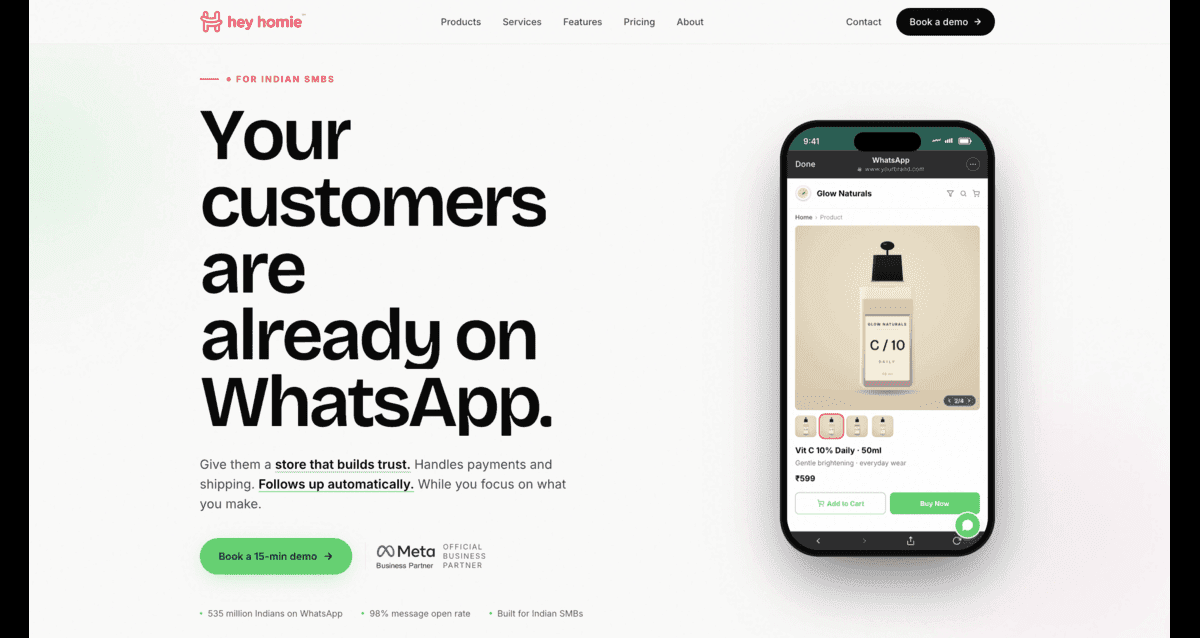
- Catalogue: the buyer scrolls your products inside WhatsApp. No new tab, no load screen.
- Questions: they ask, you (or an AI follow up) answer, right there.
- Payment: you send a UPI or card link, or confirm COD, without leaving the chat.
- Delivery: tracking updates land in the same conversation they started in.
The order finishes where the interest started. That's the whole point. We go deeper on the mechanics in how HeyHomie works, and the full vertical playbooks live under sell products and sell services.
So when do you need a website?
A site still earns its place, just not as your store:
- Discovery and SEO: Google can't read your WhatsApp catalogue. A few good pages (or this blog) is how search and AI engines find you.
- Ad landing pages: ads that click through to WhatsApp convert best with a clear, fast page that hands off to chat.
- Credibility: corporate and bulk buyers often want to "see the website" before a big order.
The right model is website for discovery, WhatsApp for the sale. The site feeds the chat, the chat closes the deal. If you're weighing a hosted store specifically, we wrote a direct breakdown in HeyHomie vs Shopify.
The honest trade offs
A WhatsApp catalogue is not magic. You give up:
- A fully branded, pixel perfect storefront.
- Deep on site analytics (you trade it for conversation level signal instead).
- Discoverability. Again, why you still want some web presence.
What you gain is the only metric that pays rent: more warm chats turning into paid, shipped orders. For a home business or SMB, that trade is almost always worth it.
The takeaway
A website asks your buyer to do the work. A WhatsApp catalogue does the work with them, in the place they already trust. If "price pls" chats are dying in your inbox, the fix usually isn't a better website. It's finishing the sale where the conversation already is.
That's exactly what HeyHomie does: turns your WhatsApp into a complete store with catalogue, payments, shipping and AI follow ups, with plans from ₹500/month. See pricing, or book a 15 minute demo.
Frequently asked
Do I still need a website if I sell on WhatsApp?
For most Indian home businesses and SMBs, no. A WhatsApp catalogue handles discovery, questions, payment and delivery inside one chat. A website becomes useful later, mainly for SEO, ads landing pages and brand credibility, but it should feed WhatsApp, not replace it.
Is a WhatsApp catalogue good for SEO?
The catalogue itself isn't indexed by Google, so pair it with a lightweight site or landing pages for search visibility. The catalogue's job is conversion, not discovery. It finishes the sale that ads, Instagram or search started.
Can I take payments inside WhatsApp in India?
Yes. With a WhatsApp commerce platform you can accept UPI, cards and COD inside the chat, send a payment link, and confirm the order without the buyer ever leaving the conversation.
Ready to put this into practice?
Turn WhatsApp into your complete commerce stack: store, payments, shipping, ads, CRM. Plans from ₹500/mo.